ODS & EC2 Installation Guide
OpenLink has released an OpenLink Data Spaces AMI (Amazon Machine Image). This AMI bundles the Virtuoso Universal Server, OpenLink Data Spaces (ODS), OpenLink Ajax Toolkit (OAT), and a collection of 3rd party applications (Wordpress, MediWiki?, phpBB3, and others).
Features and Benefits
- Point of presence on the Linked Data Web that meshes your Identity and your Data via URIs
- SPARQL? endpoint for SPARQL Protocol based access to your Data
- (X)HTML based Interactive SPARQL Query Builder for SPARQL Query By Example
- (X)HTML based Linked Data Browser/Viewer
- System generated Social Network Profile & Contact Data via FOAF?
- System generated global Data Space overview via SIOC?
- System generated OpenID and automatic integration with FOAF
- Transparent Integration with Facebook
- Transparent integration with Amazon S3 for data backup and restore
- In-built support for SyncML? which enables data synchronization with Mobile Phones
EC2 AMI Details:
| AMI ID | ami-e2ca2f8b |
| Manifest Label | virtuoso-dataspace-server |
| Manifest file | virtuoso-images/virtuoso-dataspace-server.manifest.xml |
Installation Guide:
- Get an Amazon Web Services (AWS) account.
- Signup for Amazon S3 and EC2 Web Service.
- Obtain your created AWS Access Indentifiers, Access Key ID and Secret Access Key.
- Download and Install the EC2 plugin for Firefox.
- Start the EC2 plugin from the Firefox Tools menu.
-
- Click on the blue "Credentials" button of the EC plugin to enter the AWS crendentials for accessing the Amazon EC2 service.
- Enter a name of you choice for the account and the Access Key ID and Secret Access Key obtained when signing up for the Amazon EC2 Web Service above.
-
- Select the "Security Groups" Tab and click on the blue "refresh" but which should list a "Default" group or if not use the green "Create Security Group" button to add a new one.
- In the "Grant Permissions" windows, use the green "Grant Permission" button to grant access for the TCP ports 1111, 8890 & 22 used for accessing the AMI instance.
-
- Select the "Key Pairs" Tab and click on the green "create new key pair" button to generate a SSL key (pem file) for use when attempting a secure login to your AMI instance.
-
- Select the "AMI and instances" Tab and click the blue "Refresh" button to obtain a list of available AMI's, if they are not already displayed.
- Sort using the AMI ID or Manifest Columns, and locate the row containing ami-e2ca2f8b Manifest virtuoso-images/virtuoso-dataspace-server.manifest.xml.
- Create a Virtuoso Data Space Server AMI instance by selecting the virtuoso-images/virtuoso-dataspace-server.manifest.xml manifest and clicking on the green "Launch instance(s)" button to Launch it.
- A dialog is presented prompting for start up options of which the only parameter required is the "keypair" which should be set to the one generated in step 10.
-
- Wait 4-5 minutes while the pre-configured Linux Image is created,
- Click on the blue "Refresh" button in the "Your instances" window and check the "state" column to see when the instance is "running".
-
- Select the Virtuoso ODS AMI in the "Your instances" window, right click on it and choose the "Copy Public DNS name to clipboard" item to obtain a copy of "your-ec2-instance-cname".
-
Connecting to ODS EC2 Instance
- Connect to: http://your-ec2-instance-cname:8890/ with your Web browser and log in with username/password dba/dba.
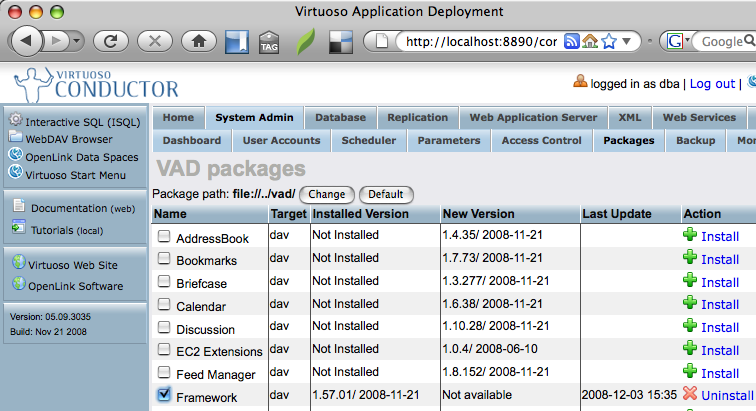
- Important Go to the Admin UI (Virtuoso Conductor) and change the PWDs for the 'dba' and 'dav' accounts.
- Give the 'SPARQL' user 'SPARQL_UPDATE' privileges (required if you want to exploit the in-built Sponger Middleware).
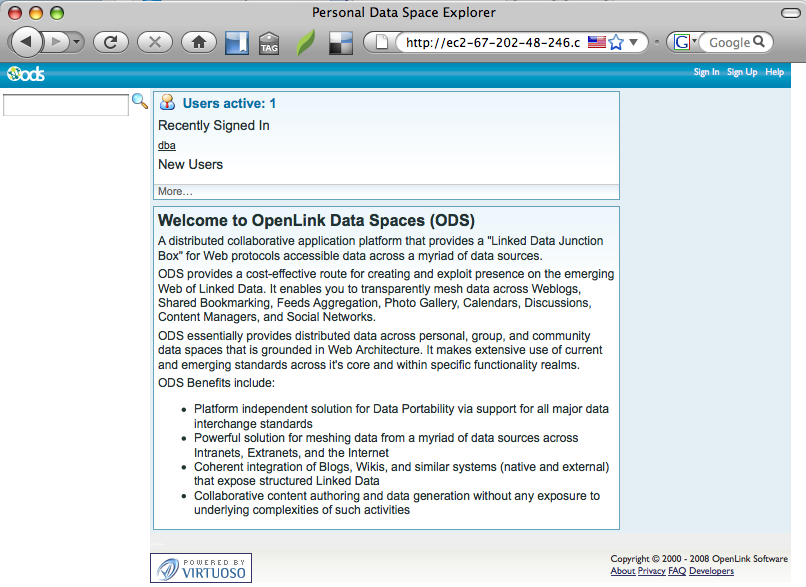
- Click on the ODS (OpenLink Data Spaces) link (or go to http://your-ec2-instance-cname/dataspace/ods/index.html) to start an Personal Editon of OpenLink Data Spaces.
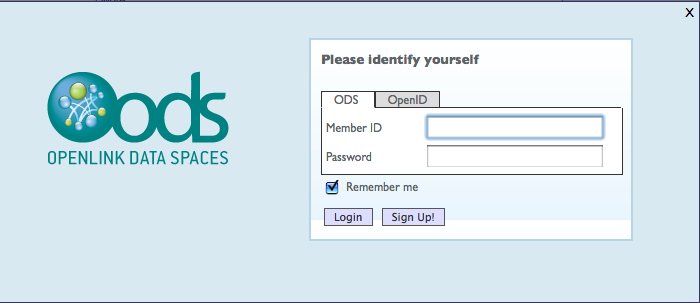
- Log in using the username and password credentials for the 'dav' account (or register a new user note: OpenID is an option here also)
- Create an Data Space Application Instance by clicking on a Data Space App. Tab
- Import data from your existing Web 2.0 style applications into OpenLink Data Spaces e.g. subscribe to a few RSS/Atom feeds via the "Feeds Manager" application or import some Bookmarks using the "Bookmarks" application
- Then look at the imported data in Linked Data form via your ODS generated URIs based on the patterns
URI for You the Person http://your-ec2-instance-cname/dataspace/person/your-ods-id#this FOAF File URI http://your-ec2-instance-cname/dataspace/person/your-ods-id SIOC File URI http://your-ec2-instance-cname/dataspace/your-ods-id
(OAT) from your Data Space instance
Install the OAT VAD package via the Admin UI and then apply the URI patterns below within your browser:
- http://host:port/oatdemo - Entire OAT Demo Collection
- http://host:port/rdfbrowser - RDF Browser
- http://host:port/isparql - SPARQL Query Builder (iSPARQL)
- http://host:port/qbe - SQL Query Builder (iSQL)
- http://host:port/formdesigner - Forms Builder (for building Meshups based on RDF, SQL, or Web Servives Data Souces)
- http://host:port/dbdesigner - SQL DB Schema Designer (note a Visual SQL-RDF Mapper is also on it's way
- http://host:port/DAV/JS/ - To view the OAT Tree (there are some experimental demos that are missing from the main demo app etc..)
Connecting to EC2 AMI Server Instance
- Locate the key created in step 10 of the Installation Guide above and run the command "chmod 700 MyKeyPair.pem".
- Connect to the EC2 AMI Server with the command "ssh -i MyKeyPair.pem <none>".
- The Virtuoso ODS installation is located in "/opt/virtuoso".
- The comand "yum update" can be used to update the EC2 AMI installation with the latest operation system and ODS updates
$ chmod 700 MyKeyPair.pem $ ssh -i MyKeyPair.pem root@ec2-67-202-24-222.compute-1.amazonaws.com The authenticity of host 'ec2-67-202-24-222.compute-1.amazonaws.com (67.202.24.222)' can't be established. RSA key fingerprint is 58:ae:0b:e7:a6:d8:d0:00:4f:ca:22:53:42:d5:e5:22. Are you sure you want to continue connecting (yes/no)? yes Warning: Permanently added 'ec2-67-202-24-222.compute-1.amazonaws.com,67.202.24.222' (RSA) to the list of known hosts. -bash-3.1# cd /opt/virtuoso/ -bash-3.1# ls bin hosting lib virtuoso-environment.csh vsp database install vad virtuoso-environment.sh -bash-3.1# yum update Loading "installonlyn" plugin Setting up Update Process Setting up repositories core 100% |=========================| 1.1 kB 00:00 extras 100% |=========================| 1.1 kB 00:00 updates 100% |=========================| 1.2 kB 00:00 virtuoso 100% |=========================| 951 B 00:00 Reading repository metadata in from local files primary.xml.gz 100% |=========================| 1.8 MB 00:01 extras : ################################################## 5699/5699 . . .